 Es Posible
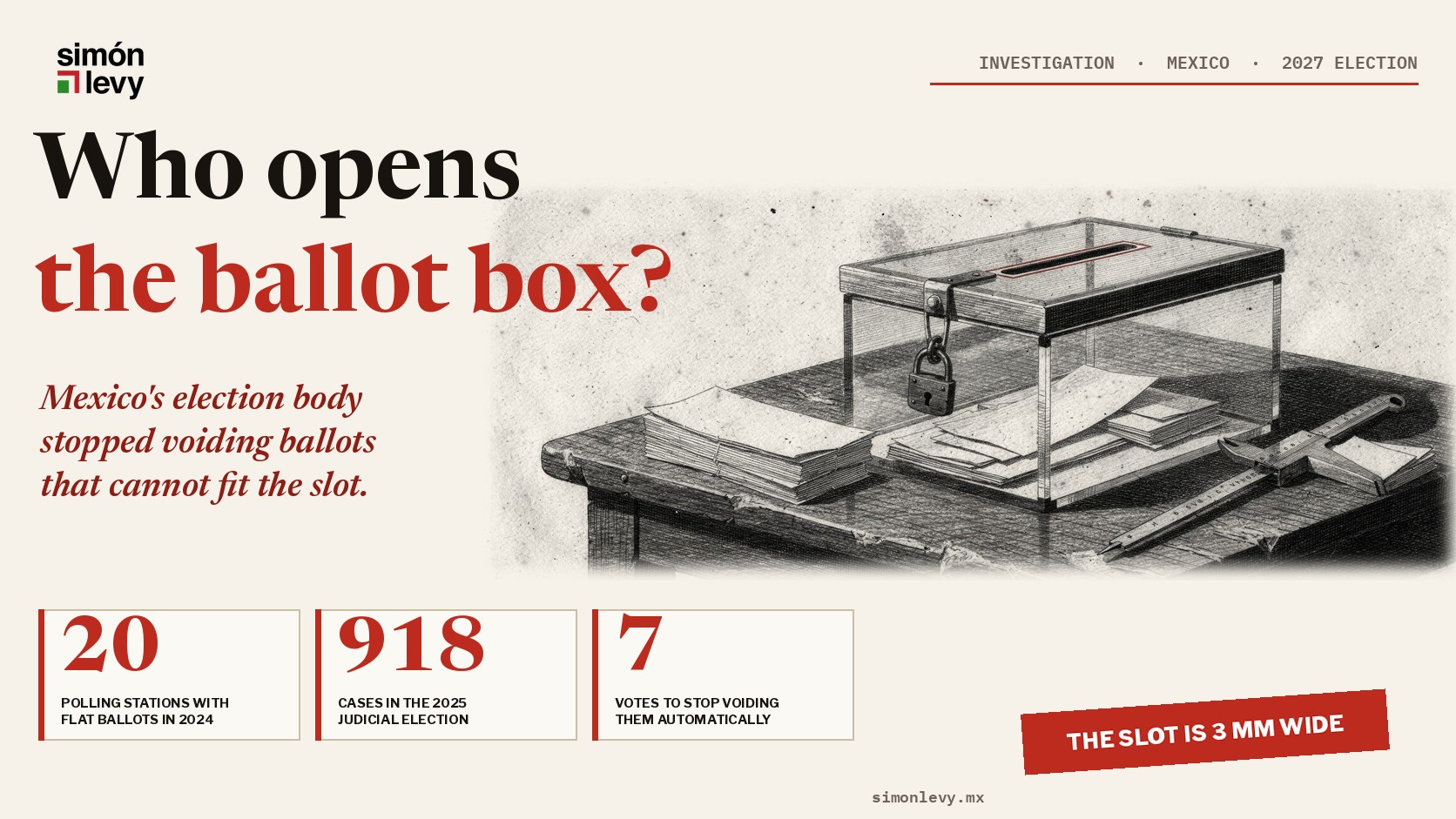
The ballot that does not fit
The slot of a Mexican ballot box is three millimeters wide and twelve centimeters long.
A federal deputies ballot is twenty by twenty-eight centimeters. Not even its short side fits. To get it in, you have to fold it.
So a completely flat ballot inside the box is a physical question before it is a legal one. It did not go through the slot. It went in through the top.
Mexico has had a name for this for decades: the pregnant ballot box. Pre-marked ballots slipped in before the polls open or after they close. The defense was just as old and just as simple. No fold, no vote.
On September 3, 2026, the General Council of the National Electoral Institute (INE) changed that rule. Now a flat ballot is set aside, an incident report is filed, and the district council decides whether to count it. It is no longer void by default.
Educational tool. Top view to scale: 12 cm by 3 mm slot, 20 by 28 cm federal ballot.
From 20 to 918 in one year
The rule was not changed in a vacuum. It was changed right after the year the problem exploded.
In the 2024 federal election, flat ballots appeared in 20 polling stations. In the 2025 judicial election, in 918 cases.
That is 46 times more in one year. The figure was given in session by the chair of the Electoral Organization Commission, Councilor Martín Faz.
That same year INE annulled 818 polling stations, almost one percent of the total. In 476 of them the cause was unfolded ballots. More than half of all annulments in a national election came from one physical signal. The tool worked. That is why its removal matters.
476 / 818 = 58.2%
If the tool that caught the most fraud in 2025 is the first one removed in 2026, the question is not legal. It is about intent.Analysis, signed · Simón Levy
Seven hands, one session
That Thursday the council voted on two safeguards. Both were loosened.
Flat ballots: 7 votes to 4. Observer screening: 7 to 4. The same seven.
Both proposals were authored by Frida Gómez Puga, one of three councilors appointed by the Chamber of Deputies on April 21, 2026, with 334 votes from Morena, PT and the Green Party against 127 from PAN, PRI and MC. The other two appointees, Blanca Yassahara Cruz García and Arturo Manuel Chávez López, voted the same way. So did Council President Guadalupe Taddei, Jorge Montaño and Norma Irene De la Cruz.
One case is odd. Uuc-kib Espadas made the strongest physical argument against flat ballots and voted for Rita Bell López's proposal to keep them out. Even so, according to the published agreements, he voted for both changes. Because of that double vote, the petition leaves him out for now.
Martín Faz, Carla Humphrey, Arturo Castillo and Rita Bell López voted against both changes. Their votes are the strongest evidence in the file: the warning was made at the table, out loud and on time.
| Councilor | For flat ballot rule | For observer change | Appointed April 2026 | Minority on both |
|---|---|---|---|---|
| Guadalupe Taddei ZavalaPresident · 2023 | ||||
| Frida Denisse Gómez PugaAuthor of both · 2026 | ||||
| Blanca Yassahara Cruz GarcíaEx Puebla institute · 2026 | ||||
| Arturo Manuel Chávez LópezEx state printing office · 2026 | ||||
| Jorge Montaño Ventura2023 | ||||
| Norma Irene De la Cruz Magaña2020 | ||||
| Uuc-kib Espadas AnconaAlso backed opposing proposal · 2020 | ||||
| Martín Faz MoraOrganization Commission | ||||
| Carla Humphrey Jordan2020 | ||||
| Arturo Castillo Loza2023 | ||||
| Rita Bell López Vences2023 |
What they say, in full
A complaint that hides the other side's argument does not survive its first read in Washington. Here it is, whole.
The majority argues three things. That the absence of a fold is not listed in the statute as a ground for nullity. That a 2025 Electoral Tribunal criterion bars excluding votes through administrative criteria not provided by law. And that a reasoned, collegial decision by the district council gives more certainty because it can be appealed.
The answer fits in one line: a flat ballot is not an administrative criterion. It is physical evidence of how the paper got in.
And the decision moves. It is no longer made at the polling station, in front of the party representatives who watched the count. It is made at the district council, after the package has traveled. That is the stretch of the chain of custody with the fewest eyes. It is exactly the stretch the opposition flagged in its appeals.
- 3 mm slot, 20 cm ballot
- In 2025 INE annulled 476 stations for this
- The decision leaves the station and its witnesses
- 300 councils, 300 standards
- No fold is not a ground in the statute
- A 2025 criterion bars excluding votes
- The district council decides with reasons
- The decision can be appealed
The filter that caught 270
The second safeguard was one list checked against another.
Since a 2022 Electoral Tribunal order, INE checked everyone applying to be an election observer against the rosters of social program operators, including the "Servidores de la Nación," the federal cash-transfer field staff. With the same majority of seven, that check is gone. Now a signed statement is enough.
Taddei defended the change with her own numbers: 24 caught among 34,881 applicants in 2024, and 270 among 316,430 in 2025.
Read it backwards. The filter caught 270 government program operators who wanted to watch the polls. Under the new rule, a signature is all they need. And in the judicial election, foreign visitors and observers reported people accredited as observers handing out pre-filled voting guides outside polling stations.
Here the Tribunal has already moved. Magistrate Felipe Fuentes Barrera filed a draft ruling that partially revokes agreement INE/CG548/2026 and orders verification before accreditation. The Superior Chamber has it on its September 23 session.
Educational tool. Applies the rate observed in 2025 (270 public servants among 316,430 applications, 0.085%) to the number you choose. The 2027 scenario is illustrative, not an official projection.
Each decision can be argued. Together they point one way
One decision is a technical debate. Four in the same direction are a policy.
August 2024: INE approves the allocation of proportional seats that gave the governing coalition about 73 percent of the Chamber with about 54 percent of the vote. That majority made the judicial overhaul possible. July 2026: it approves monitoring news shows for "indirect discursive mechanisms of disqualification" of candidates. The Tribunal struck it unanimously in August for its effect on journalism. September 2026: flat ballots and observers.
Every time, an objective check is removed and a discretionary decision is left to the same bodies whose independence is in question.
Taddei heads INE
Sworn in on April 4 as Council President.
Overrepresentation
The General Council approves an allocation giving about 73% of the Chamber with 54% of the vote.
Espino, Executive Secretary
Appointed December 1 with 10 of 11 votes.
Ballot boxes by direct award
Tender declared void. Cajas Graf and TOL Producciones supply 63,549 boxes and 432,745 booths.
Judicial election
918 flat ballot cases. 476 stations annulled for that cause.
The supplier runs the budget
García González, former representative of Cajas Graf and Zeg, named acting head of Administration.
Three new councilors
334 votes to 127. Gómez Puga, Cruz García and Chávez López.
García González out
Press reports his departure after the contracts were published.
Newsroom monitoring
INE approves tracking "indirect disqualification." The Tribunal strikes it unanimously in August.
Two safeguards fewer
Flat ballots and observer screening: 7 to 4 both, the same seven votes.
Espino resigns
The day before the process starts. Acting: Roberto Félix, from Sonora.
Appeals
PAN, PRI, MC and Somos challenge CG542 and CG548 at the Superior Chamber.
Superior Chamber
Draft ruling to partially revoke the observer agreement.
Election day
Full Chamber of Deputies and offices in all 32 states.
The flat ballot is not decided at the polling station. It is decided at the district council, far from the witnesses.Analysis, signed · Simón Levy
Who built the box?
The whole public debate is about what to do with the ballot found inside the box. Nobody has asked who made the box.
The 63,549 ballot boxes and 432,745 voting booths for the 2025 judicial election were supplied, by direct award, by Cajas Graf together with TOL Producciones.
The tender had been declared void. In 2023 Mexico's Financial Intelligence Unit froze Cajas Graf and Corporativo Zeg on suspicion of money laundering. They won amparo rulings on procedural grounds in mid-2024. No judge ruled on whether the money was lawful.
The legal representative of those companies was Jesús Octavio García González. In September 2025, Guadalupe Taddei named him acting head of Administration at INE, a post that manages about 14 billion pesos. The press reported his departure in April 2026.
The thread goes further. In 2021 Taddei, then president of Sonora's electoral institute, contracted Cajas Graf for 46.9 million pesos. That same year Claudia Arlett Espino, president of Chihuahua's institute, gave it 33.9 million. Espino became INE's Executive Secretary in December 2024 and resigned on September 9, 2026, the day before the electoral process began, citing health reasons in her letter. Her acting replacement, Roberto Félix, was Executive Secretary of Sonora's institute from 2014 to 2020.
The election with 46 times more flat ballots was cast in boxes from a supplier Mexico's FIU had frozen, represented by the man who later ran INE's money. What Washington is asked to do is review both: the rule and the supply chain.
C Cajas Graf
INE direct award in 2025 for judicial election boxes and booths, with TOL Producciones. Frozen by Mexico's FIU in 2023.
There is no crime. There are visas
The uncomfortable truth first. There is no U.S. federal crime for mismanaging a foreign election.
What does exist is Section 212(a)(3)(C) of the Immigration and Nationality Act: denying or revoking visas for those who undermine democracy abroad.
The State Department has already built country policies on that basis for Sudan, Nigeria, Bangladesh, Zimbabwe, Guatemala, Georgia and Ghana. Zimbabwe's lists manipulation of the electoral process and corrupt acts that undermine it. There is none for Mexico. And since 2025 Washington has revoked the visas of dozens of Mexican politicians without publishing a standard.
The second track is contract corruption: Section 7031(c) and Executive Order 13818, Global Magnitsky. If the leaders of the Senate or House foreign affairs committees request it in writing, the executive branch has 120 days to answer. The third track, money laundering, opens only if the money touched U.S. banks or property. That tracing has begun.
Four filings and 256 days
The complaint is four documents in English, dated September 23, 2026.
One to the Secretary of State on visas. One to Treasury and State under Global Magnitsky and 7031(c). One to the FBI and the Justice Department on money laundering. And a letter to four congressional committees.
The visa petition asks for a policy on undermining democracy in Mexico before June 6, 2027, and for six councilors to be reviewed under it: Guadalupe Taddei Zavala, Frida Denisse Gómez Puga, Jorge Montaño Ventura, Norma Irene De la Cruz Magaña, Arturo Manuel Chávez López and Blanca Yassahara Cruz García.
The Global Magnitsky submission asks for a corruption review of Taddei, Espino and García González, and of Cajas Graf, Corporativo Zeg and TOL Producciones. The laundering referral states plainly that a U.S. nexus is not established and asks the FBI to check.
The piece that starts the clock is the letter to Congress. If the chair and ranking member of a single committee sign the request before February 6, 2027, the law requires the President to answer within 120 days, before the election.
The clock is running. A visa policy published after the election punishes. Published before, it deters.
to election day, June 6, 2027
- A visa restriction policy on undermining democracy in Mexico, INA 212(a)(3)(C)
- Review of six councilors under that policy
- Corruption review of the supplier network: 7031(c) and Global Magnitsky
- A record in the 2026 Human Rights Report
- An OAS mission mandated on chain of custody
- A committee request under 22 U.S.C. 10102(d): answer within 120 days
- FBI and DOJ review of a possible U.S. laundering nexus